 Fraunhofer Institute for Building Physics IBP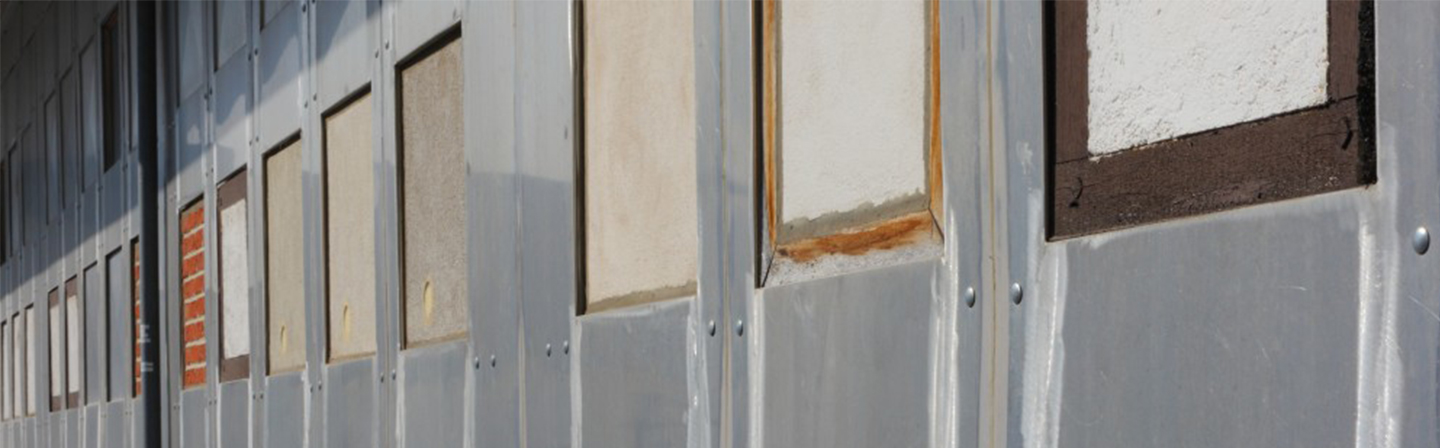
Air-conditioned test hall
Hygrothermics
Test Facility for Wall and Roof Constructions
At our Holzkirchen site, we operate a state-of-the-art climate-controlled test hall as well as the world’s largest outdoor test site for investigating building materials, construction systems, building components, and system components at full scale (1:1). Here, we analyze the performance of building components under real weather conditions and generate reliable data for assessing the durability of construction products. In the climate-controlled test hall, customized and innovative wall and roof constructions can be installed and examined under defined climatic conditions. Precise measurements of temperature and moisture distribution within the building components are carried out, complemented by continuous monitoring of heat flows and hygrothermal processes. In addition, we offer testing of tear resistance and adhesive tensile strength on external thermal insulation composite systems (ETICS) to objectively evaluate the performance and quality of façade systems.
Outdoor Testing Under Real Weather Conditions
The outdoor test site provides ideal conditions for long-term investigations. Due to the local climate - characterized by high solar radiation in summer, cold winters, and intense driving rain - it enables realistic testing under extreme environmental conditions. Dedicated test areas for flat and pitched roofs, as well as flexible wall assemblies, allow for the analysis of a wide range of construction variants.
Thanks to the modular design of the climate-controlled test hall, both small-scale wall elements (approx. 50 cm × 50 cm) and large-scale elements (up to approx. 2.5 m × 3 m) can be integrated. The roof of the experimental building is divided into test sections approximately 2.5 m wide and can be equipped with monopitch, gable, or flat roof constructions.
Combining Field Testing and Simulation
A key added value lies in the combination of outdoor testing and hygrothermal simulations (e.g., WUFI®). This approach allows for validation of experimental results through simulation tools, enables parametric studies, and significantly reduces the overall effort required for outdoor testing.
Several meteorological monitoring stations located on the test site and in the surrounding area have continuously recorded all relevant climate parameters for decades. These data form the basis for detailed microclimate analyses as well as hygrothermal and energy simulations.
Our comprehensive expertise allows us to tailor field tests precisely to our clients’ research questions. We offer a wide range of services, including investigations of
- thermal insulation performance of materials and systems
- moisture behavior and durability
- moisture buffering capacity and thermal properties of specialized material layers, e.g., phase change materials (PCM) oand low-emissivity (low-E) materials
- temperature, moisture, and heat flow monitoring


Are you planning to test your construction products or systems?
Please contact us, we will develop customized testing concepts tailored to your requirements and support you from experimental planning through in-depth analysis to the targeted optimization of your products.
| Measurement | Moisture-related properties Total water content Exposure to driving rain |
| Standard | Own testing method |
| Measurement object | Small-scale wall elements Large-scale wall elements Roof elements |
Technical data
| Sample size | Small-scale wall elements for removal and weighing of mass changes: timber frame approx. 50 cm × 50 cm, 20 cm or 40 cm depth Large-format wall elements: approx. 2.5 m × 3 m; thickness depending on construction design Roof elements: span 6.0 m and grid width 2.5 m |
Outdoor exposure of wall elements Outdoor exposure of roof elements |
Construction of a complete wall cross-section Installation in a test building facing west and/or east Construction of a complete roof cross-section Installation on a test building with main roof surfaces facing west and/or east |
Special features
tr>
| DAkkS-Accreditation D-PL-11140-11-00 |
Flexible accreditation of the testing laboratory according to DIN EN ISO/IEC 17025 |
| Issuance of test reports | |
| Small-scale wall elements | Thanks to a special locking mechanism, the wall elements can be easily removed and weighed using a forklift. This allows discontinuous measurement of changes in the elements’ weight, which generally correlate with variations in total moisture content. |
| Large-scale wall elements | Integration of customized construction solutions (no building permit or regulatory approval required); Monitoring of temperature, moisture conditions, and heat flows; Destructive material testing possible. |
| Roof elements | A wide range of construction configurations can be realized based on the predefined support areas of the existing building roof; Customized roof designs and inclination possible; Monitoring of temperature, moisture conditions, and heat flows; Destructive material testing possible |
More information
Determination of moisture uptake and release in small-scale wall elements exposed to controlled indoor winter climate conditions on the interior side and to natural weathering on the exterior side. The method is used, for example, to compare different exterior coatings or insulation systems. In addition to moisture content, temperature profiles and heat flows can also be measured.