 Fraunhofer Institute for Building Physics IBP
BES Model Validation: Measurement Datasets from Twin House Experiments of IEA EBC Annexes 58 and 71 for the Validation of Dynamic Building Simulation.
more infoProjects and References
-
-

The BioAdapt project develops and tests a user-friendly software tool for the evidence-based planning and evaluation of climate adaptation and biodiversity protection measures.
Climate adaptation and biodiversity protection need to be more closely interconnected and developed through integrated approaches. For planning processes, this means combining climatic and ecological information, databases, climate adaptation and biodiversity strategies, as well as interdisciplinary expertise - a major challenge, particularly as no digitally supported methodology for the integrated planning of climate adaptation and biodiversity protection currently exists. As a result, planning processes are often complex and time-consuming, while potential synergies remain difficult to identify. The BioAdapt project addresses this challenge by developing a user-friendly planning tool that integrates data and methodologies for the evidence-based design and evaluation of climate adaptation and biodiversity protection measures, including the necessary databases.
more info -

As part of the funding initiative “Resource-Efficient Circular Economy – Urban Mining” launched by the German Federal Ministry for Research, Technology and Space (BMFTR), the research project “RueBe” was initiated in November 2025. The project aims to recover and reintegrate mineral waste from DK0 landfills into sustainable building material cycles. It is coordinated by the Fraunhofer Institute for Building Physics IBP.
more info -

The BioAdapt project develops and tests a user-friendly software tool for the evidence-based planning and evaluation of climate adaptation and biodiversity protection measures.
Climate adaptation and biodiversity protection need to be more closely interconnected and developed through integrated approaches. For planning processes, this means combining climatic and ecological information, databases, climate adaptation and biodiversity strategies, as well as interdisciplinary expertise - a major challenge, particularly as no digitally supported methodology for the integrated planning of climate adaptation and biodiversity protection currently exists. As a result, planning processes are often complex and time-consuming, while potential synergies remain difficult to identify. The BioAdapt project addresses this challenge by developing a user-friendly planning tool that integrates data and methodologies for the evidence-based design and evaluation of climate adaptation and biodiversity protection measures, including the necessary databases.
more info -

View of the elevated highway in Ludwigshafen, where approximately 310,000 tons of concrete will arise during demolition.
The construction industry is facing a major challenge: each year, around 90 percent of all domestic mineral raw materials used in Germany are consumed by construction projects. At the same time, many valuable construction wastes - particularly from older buildings - are landfilled or insufficiently recycled. Structures built between the 1960s and 1980s are especially affected, as they often contain fibrous silicate minerals. These legacy contaminations frequently result in otherwise recyclable concrete having to be disposed of as hazardous waste. The ReAsCon project therefore pursues an innovative approach for processing and recovering such unwanted legacy materials in the construction sector.
more info -

Site plan of the Neckarpark urban district showing the heat exchanger in the sewer system, the central heating plant, and the two heating networks.
Since 2013, the new urban district Neckarpark has been developed on the site of the former freight yard brownfield in Stuttgart-Bad Cannstatt. Municipal wastewater serves as the primary energy source for the district heat supply. Its thermal energy is harnessed via a heat pump system and distributed through a low-temperature district heating network. To increase the efficiency of the district heating network, developers were required from the outset to significantly exceed the statutory energy performance requirements for new buildings (minimum standard: KfW Efficiency House 55). At the launch of the project and for several years thereafter, the Neckarpark project - with a thermal extraction capacity of 2,100 kW from wastewater - was by far the largest wastewater heat recovery project in Germany. As such, Neckarpark serves as a nationwide benchmark for sustainable energy supply in urban districts.
more info -
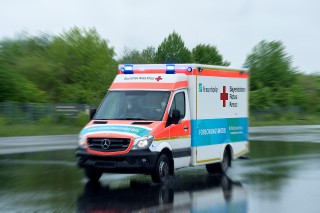
The SafeCar project focuses on detecting the spread of Corona viruses in ambulances and eliminating them swiftly and efficiently.
The SafeCar project aimed to reduce the risk of infection for paramedics and patients in ambulances by finding ways of eliminating viruses in a swift and efficient manner.
more info -
How efficiently do air purification technologies eliminate viruses from the air?
Highlights from research and development
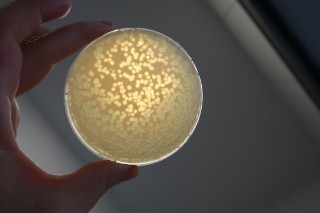
Plaque assay for measuring the concentration of test viruses with the new test method: The bright spots on the agar dish represent plaques caused by (active) virus particles capable of reproduction.
In the “Fraunhofer vs. Corona” program, Fraunhofer IBP has established practical methods to demonstrate the efficiency of air purification technologies.
more info -
Do mobile air purifiers in classrooms effectively reduce the risk of infection?
Highlights from research and development
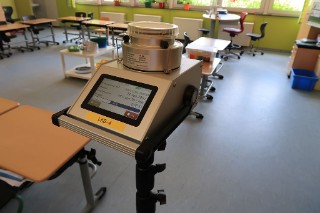
Air sampler with gelatin filter positioned directly below one of the two indoor air purifiers.
Mobile indoor air purifiers remove infectious aerosols from the air or deactivate the pathogens contained within.
more info -
Biogas sensor technology
Highlights from research and development
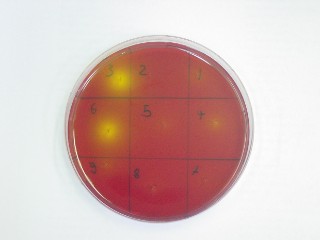
The information recorded by the sensors enables the ideal fermentation conditions to be determined that are necessary in order to generate high quality biogas.
Scientists at the Fraunhofer IBP are developing an online process analysis to detect and verify organosulfur compounds.
more info